
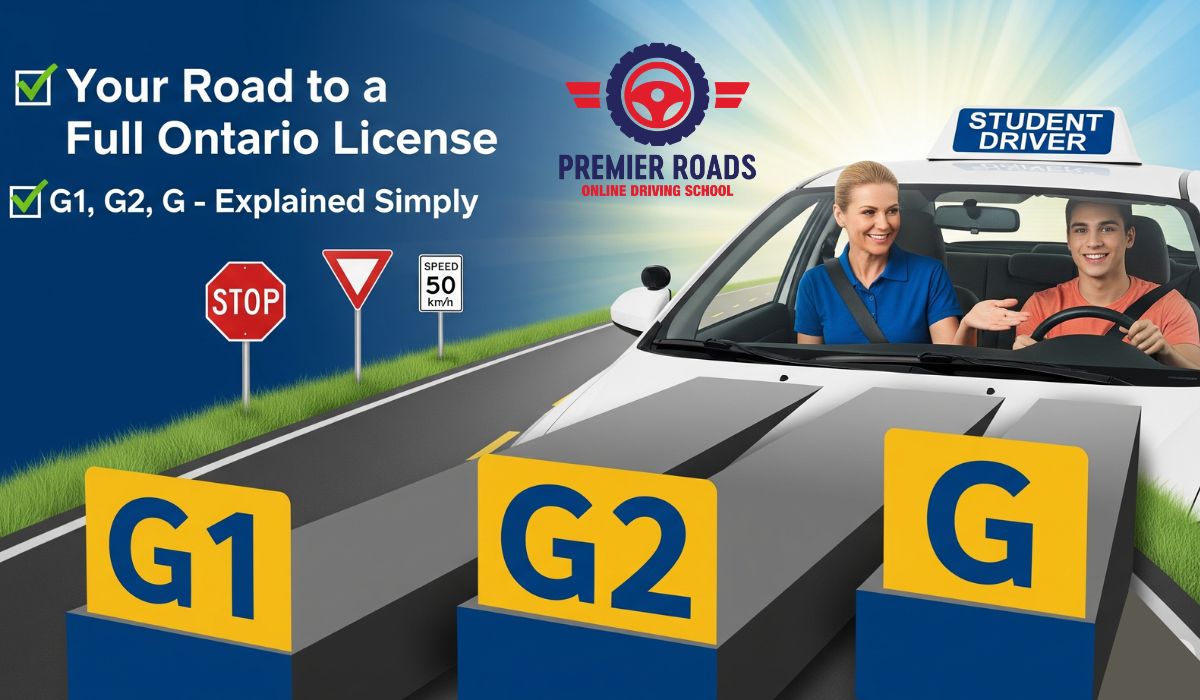
The Ontario Graduated Licensing System helps new drivers learn safely through three stages G1, G2, and Full G. In simple terms, you begin with a written test, practice with restrictions, complete two road tests, and gradually gain full driving privileges.
Understanding the Ontario Graduated Licensing System (G1 → G2 → Full G)
If you’re a new driver, the Ontario Graduated Licensing System is designed to help you build skills step-by-step. Instead of immediately receiving full driving privileges, you progress through structured learning stages. This approach has successfully reduced collision rates among novice drivers by over 20% in Ontario.
The three stages include:
- G1 Licence – Knowledge-based entry level
- G2 Licence – Intermediate licence after your first road test
- Full G Licence – Final licence after completing the second road test
Each level has its own rules, timelines, and test requirements. Below is a breakdown that fits naturally within the learning journey.
Ontario Driver Licensing Levels Overview
| Licensing Stage | Type | What It Allows | Key Restrictions | Required Test |
|---|---|---|---|---|
| G1 Licence | Beginner | Drive with supervision | Zero alcohol, no highways 400-series, must have fully licensed driver | Written knowledge test |
| G2 Licence | Intermediate | Drive alone | Zero alcohol (under 21), nighttime passenger limits (under 19), certain restrictions lifted | G2 Road Test (G1 Exit Test) |
| Full G Licence | Fully Licensed | Full driving privileges | None for most drivers | G Road Test (G2 Exit Test) |
This table provides a snapshot of how the Ontario driving system works, from beginner to fully licensed driver, allowing you to understand your journey at a glance.
Stage 1: The G1 Licence – Rules, Waiting Period & What to Expect
The G1 licence is the first major step in the Ontario Graduated Licensing System. You obtain it by passing a written knowledge test that covers road rules, signs, and safe driving practices.
G1 Licence Rules (Key Points)
These are the core Ontario G1 license rules every new driver must follow:
- You must maintain 0% blood alcohol level at all times.
- You cannot drive alone a fully licensed driver with at least 4 years of experience must sit in the front passenger seat.
- No driving on 400-series highways or high-speed expressways unless supervised by a certified driving instructor.
- All passengers must have working seatbelts.
- Driving is not allowed between midnight and 5 AM if you’re under 19 driving in certain situations.
How Long Between G1 and G2 in Ontario?
The standard holding period is:
- 12 months, or
- 8 months if you complete an MTO-approved driving course.
If you’re planning professional training, check out structured programs such as Driving Courses Ottawa for faster progression and stronger skills.
Preparing for the G1 Test
The G1 test includes:
- 40 multiple-choice questions
- Road signs and rules
- Vision test
- High passing accuracy required
Studying the MTO handbook and taking practice tests is the best way to prepare.
Stage 2: The G2 Licence – Requirements & Privileges
After gaining experience as a G1 driver, your next major milestone is upgrading to the G2.
Ontario G2 License Requirements
To qualify for the G2 licence, you must:
- Hold your G1 for the mandatory 8–12 months.
- Pass the G1 Exit Road Test, which assesses your basic driving skills.
- Understand and follow all G2 rules.
What You Can Do With a G2 Licence
G2 drivers enjoy far more freedom compared to G1:
- You can drive alone.
- You can drive on any road, including 400-series highways.
- You can drive at any time of the day.
However, some restrictions still apply, especially if you’re under 21.
G2 Licence Restrictions
- Zero alcohol requirement continues for all drivers under 21.
If you’re 19 or younger, there are passenger restrictions between midnight and 5 AM:
- First 6 months: Only one passenger under 19.
- After 6 months: Up to three passengers under 19.
These restrictions exist because nighttime collisions are more common among new drivers.
G2 Road Test (G1 Exit Test) – What to Expect
The G2 test checks whether you can safely handle:
- Turning
- Signal use
- Lane changes
- Parking
- Basic road navigation
- Obeying speed limits and signs
A successful G2 test shows that you’re ready to drive independently with moderate restrictions.
Before your test, it’s beneficial to take a few professional lessons. Many new drivers improve their passing odds greatly with refresher training, often included in structured programs like Driving Courses Ottawa.
Why the Graduated System Works
Ontario’s system is built on research-backed novice driver guidelines, which show new drivers are most at risk during their first two years. The step-by-step progression ensures:
- Reduced accidents
- More experience before full privileges
- Better confidence and skill development
- Enforcement of safe habits early on
Stage 3: Full G Licence – Final Step to Becoming a Fully Licensed Driver
Once you’ve gained enough real-world experience with your G2 licence, you’re ready for the final stage of the Ontario Graduated Licensing System: the Full G Licence. This level gives you full driving privileges without the restrictions placed on G1 and G2 drivers.
Full G Licence Ontario Process
To obtain your Full G licence, you must:
- Hold a valid G2 licence for 12 months (minimum).
- Book and pass the G Road Test (also known as the G2 Exit Test).
This test is more advanced than the G2 test because it’s designed to evaluate your highway skills, advanced driving techniques, hazard awareness, and decision-making abilities.
What the G Road Test Includes
During the Full G road test, you will be evaluated on:
- Highway merging and exiting
- Passing and lane discipline
- Emergency stopping
- Advanced observation skills
- Speed control and safe following distance
- Smooth braking and acceleration
- Complex traffic situations
The examiner wants to ensure that you can not only drive safely but also predict and react to risky situations proactively.
Benefits of a Full G Licence
Once you pass your G test, you gain:
- Full driving freedom
- Permission to carry passengers without restrictions
- Allowed to drive at any time, on any road
- No alcohol restrictions for drivers 21+
- Lower insurance rates (in most cases)
This milestone marks the completion of the Ontario driving licence stages, giving you complete control and confidence on the road.
Ontario Driving Test Steps (Complete Overview)
To help simplify the entire journey, here’s a quick breakdown of every stage in order:
1. Study for the Knowledge Test
- Read the MTO handbook
- Take online quizzes
- Bring required documents to the DriveTest centre
2. Pass the G1 Test
- Complete the written exam
- Undergo a vision test
- Begin driving with restrictions
3. Get Practice & Take Professional Training
- Log driving hours in different conditions
- Consider enrolling in a structured program like Driving Courses Ottawa for a faster G2 timeline
4. Book & Pass the G1 Exit (G2) Road Test
- Show basic driving competence
- Get G2 licence and drive independently
5. Gain Experience as a G2 Driver
- Drive safely for at least 12 months
- Improve highway and advanced-driving skills
6. Book & Pass the G2 Exit (G) Road Test
- Demonstrate high-level driving skills
- Earn FULL G status
Why Ontario’s Graduated Licensing System Matters
Ontario’s novice driver guidelines and multi-phase system are designed based on decades of research showing that inexperienced drivers are more prone to collisions. By gradually increasing responsibility, Ontario ensures:
- Better long-term driving habits
- Lower crash risks among new drivers
- Structured progression that builds confidence
- Safer roads for everyone
This system isn’t just a legal requirement it’s a safety framework that truly works.
Top FAQs About the Ontario Graduated Licensing System
What is the graduated licensing system in Ontario?
The Ontario Graduated Licensing System is a step-by-step program for new drivers. It progresses from G1 → G2 → Full G, ensuring novice drivers gain experience and follow safety rules before obtaining a full licence.
How does graduated licensing work in Ontario?
New drivers start with a G1 licence after passing a written test, then advance to G2 with a road test, and finally earn a Full G licence. Each stage has specific rules and restrictions to reduce risk while learning.
How long is it between G2 and G in Ontario?
Drivers must hold a G2 licence for at least 12 months before taking the G road test to earn a Full G licence. Completing this period helps ensure enough driving experience before full privileges.
Can I drive alone with a GDL?
You cannot drive alone with a G1. G2 drivers may drive independently but must follow certain restrictions if under 21. Full G licence holders have no restrictions and can drive alone anywhere.
What are GDL restrictions?
GDL restrictions vary by stage: G1 drivers need a supervising driver and cannot drive on highways; G2 drivers may drive alone but have passenger and alcohol limits under 21; Full G drivers have no major restrictions.
Final Thoughts
The Ontario Graduated Licensing System provides a safe, structured, and effective way for new drivers to build experience and grow into confident road users. By moving through the G1, G2, and Full G stages, you develop essential skills progressively from basic understanding to advanced driving proficiency.
Whether you’re studying for your G1, preparing for your G2, or polishing your skills for the Full G test, following the right guidance and getting proper training can make the entire journey smoother. Consider exploring resources like Driving Courses Ottawa if you need support along the way.
The road to becoming a fully licensed driver in Ontario may take time, but each step is designed to protect you, your passengers, and everyone else on the road. Stay patient, stay focused, and you’ll reach your Full G confidently and successfully.
Comments are closed