
Ready to Start Driving? Book Your Lesson Today!
Don’t wait start your journey to becoming a confident driver today. Premier Roads offers MTO-approved courses, flexible lessons, and expert guidance to help you succeed. Book your lesson now and drive with confidence.
No amount of studying the rulebook can fully prepare a new driver for the moment a cyclist swerves into their lane, a car ahead brakes hard without warning, or black ice turns a routine turn into a slide. These are the moments driving training is really built for. It’s not just about learning to signal and shoulder-check correctly; it’s about building the instincts to respond calmly and correctly when something goes wrong.
At Premier Roads, we treat this as one of the most important parts of our driving courses in Ottawa. Below, we break down exactly how structured driving training and defensive driving lessons prepare students for the unpredictable situations they’ll eventually face on real roads, and why this kind of preparation is nearly impossible to replicate on your own.
Why Unexpected Situations Are the Real Test of a Driver
Passing a road test proves a driver can follow the rules under controlled, predictable conditions. But real driving is rarely that tidy. A pedestrian steps off the curb without looking, a deer runs across a rural road, or a sudden downpour cuts visibility in half. According to the Official MTO Driver’s Handbook, unprepared drivers too often freeze up or react the wrong way when an emergency happens, which is exactly why practising these scenarios ahead of time, in a controlled setting with an instructor, makes such a measurable difference.
This is the gap that quality driver education is designed to close: turning panic into a practiced, almost automatic response.
Building Hazard Response Through Scanning Habits
One of the first things instructors teach isn’t a manoeuvre at all, it’s a way of looking at the road. Defensive driving is built on three core ideas: visibility, space, and communication. Instructors train students to keep their eyes constantly moving, scanning far down the road rather than fixating on the car directly ahead, and checking mirrors every few seconds. The goal is simple: the farther ahead a driver is looking, the less likely they are to be caught off guard, and the more time they have to avoid a hazard before it becomes a crisis.
This habit is drilled into students from the very first behind-the-wheel session in our in-car driving lessons, because it’s the foundation everything else builds on. A driver who is scanning properly rarely needs to slam on the brakes, because they saw the problem developing three seconds earlier than a driver who wasn’t.
Practising Emergency Braking in a Controlled Setting
Emergency braking is one of the clearest examples of a skill that has to be practiced, not just explained. Knowing intellectually that a car has anti-lock brakes doesn’t mean a driver will react correctly the first time they slam the pedal and feel the pulsing vibration under their foot. That surprise, in a real emergency, can cause a driver to ease off the brake at exactly the wrong moment.
That’s why instructors walk students through controlled emergency stops, ideally in an empty lot or quiet area, so the sensation is familiar before it’s ever needed for real. Ontario’s own driver education guidance recommends practising this kind of emergency braking under the supervision of a qualified instructor, precisely because it’s not something a driver should be experiencing for the first time in an actual crisis. This kind of guided repetition is built into our 10-Hour Comprehensive Package, which moves students from basic vehicle control through to advanced hazard response over the course of the program.
Teaching Decision Making, Not Just Reactions
A skilled driver doesn’t just react to a hazard; they choose the safest possible response in a split second. Should you brake, swerve, or hold your lane? The right answer depends on speed, road conditions, surrounding traffic, and what’s around the vehicle. This kind of decision making can’t be memorized from a handbook; it has to be practiced through realistic, low-risk scenarios where an instructor can talk a student through their options in real time.
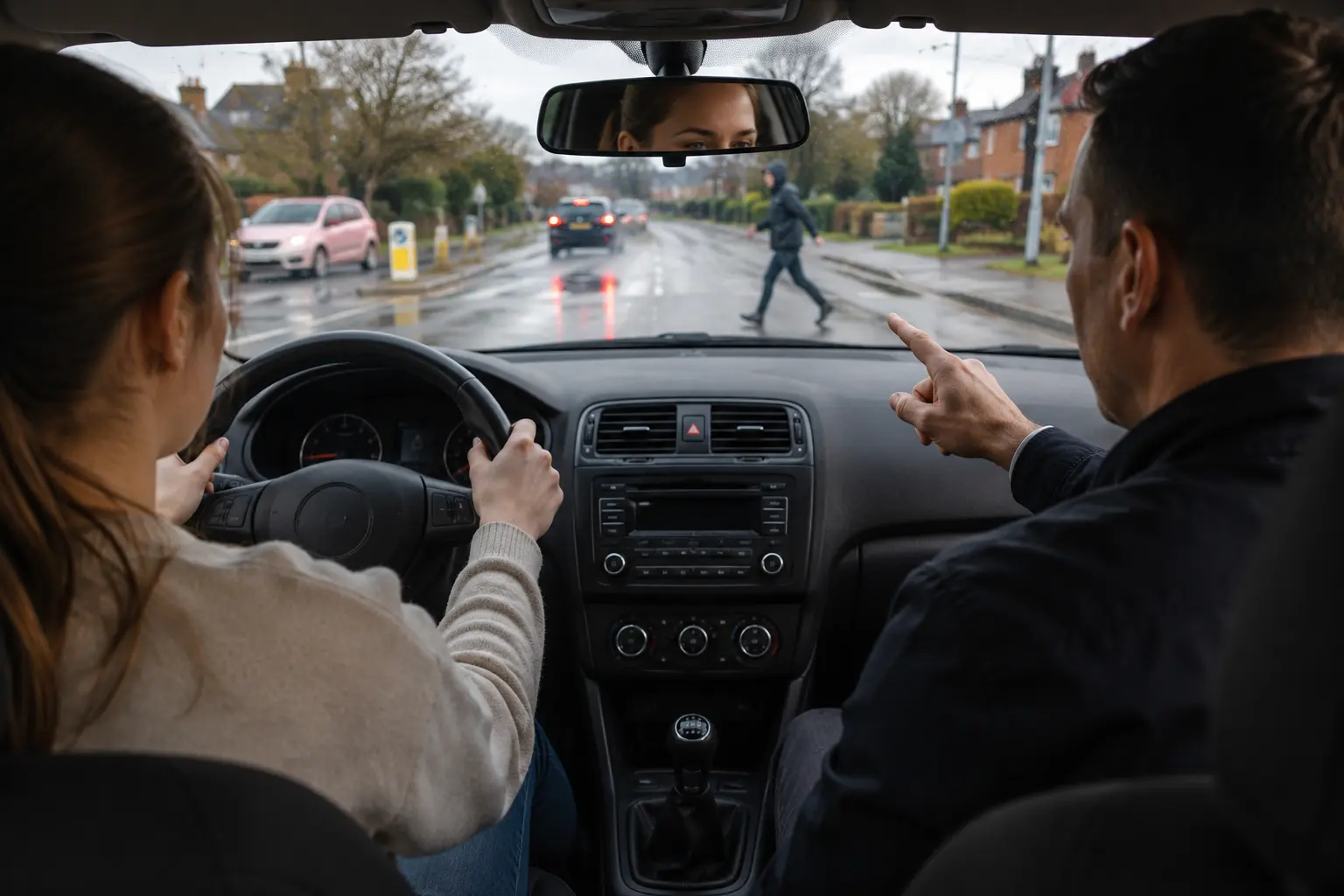
Instructors deliberately expose students to a range of situations, unexpected lane closures, pedestrians stepping out unpredictably, vehicles merging aggressively, so that decision-making under pressure becomes a rehearsed skill rather than a moment of panic. Over time, students learn to evaluate a hazard and commit to a response, rather than hesitating or overcorrecting.
Preparing for Weather and Visibility Challenges
Ottawa drivers deal with a wide range of conditions across the year, from icy winter mornings to sudden summer downpours. New drivers often haven’t yet built an intuition for how these conditions change stopping distances, visibility, and vehicle handling. A dry-pavement habit that works fine in July can be dangerous on a slushy road in January.
Instructors use these seasonal realities as teaching moments, adjusting following distance, demonstrating how reduced visibility changes reaction time, and reinforcing habits like using headlights and defrosters properly. This kind of contextual, weather-specific coaching is one of the biggest advantages of professional driving training delivered on real Ottawa roads, rather than in a simulator or classroom alone.
Responding Correctly to Emergency Vehicles and Unusual Traffic Events
New drivers are sometimes caught off guard by less common but high-stakes situations, like an emergency vehicle approaching from behind with lights and sirens active. The correct response, checking mirrors, signalling early, and pulling over gradually rather than braking suddenly, isn’t always intuitive under pressure. Instructors walk students through these procedures explicitly, so the reaction becomes automatic rather than improvised.
This kind of scenario-based coaching reflects official Ontario driving guidance and is one of the reasons structured lessons consistently outperform casual, unsupervised practice when it comes to building real hazard response.
Why This Preparation Matters Beyond the Road Test
A road test only lasts about 20 to 30 minutes, and examiners can’t manufacture every possible hazard a new driver will eventually face. That means a huge part of real preparation has to happen during training itself, through repetition, guided feedback, and exposure to a wide range of realistic scenarios. This is exactly why Premier Roads structures its courses to go beyond simple test preparation and toward genuine road readiness.
Whether a student is working through our Online BDE Course or building hands-on experience through in-car lessons, the goal is the same: to leave every session more capable of recognizing a developing hazard and responding to it calmly, not just passing a test.
What to Look for in a Driving School That Prioritizes Real Preparation
Not every driving course dedicates real time to hazard response and emergency scenarios, some focus almost entirely on passing the written test and the basic manoeuvres needed for a road test. If genuine road readiness matters to you, it’s worth asking a few questions before enrolling:
- Does the course include real, on-road practice, or only classroom and simulator time? Hazard recognition and emergency braking need to be felt behind the wheel, not just described.
- Are instructors certified and experienced with new, nervous drivers? A calm, patient instructor makes a measurable difference in how well a student absorbs high-pressure scenarios.
- Does the program cover seasonal driving conditions? Ottawa’s winters and sudden summer storms demand specific skills that a generic course may not address.
- Is decision-making coached explicitly, not just corrected after the fact? Students should understand why a response was right or wrong, not just that it was.
Programs like our 5-Hour Foundation Package and 10-Hour Comprehensive Package are structured with these questions in mind, layering foundational vehicle control first and building toward more complex, real-world hazard response as students progress. It’s also worth reviewing the Official MTO Driver’s Handbook directly, since it outlines the exact defensive driving principles, visibility, space, and communication, that instructors are trained to reinforce on the road.
Final Thoughts
Unexpected road situations are inevitable for every driver, but panic and poor decision-making don’t have to be. With the right driving training, defensive driving lessons, and structured driver education, new drivers build the instincts to handle emergency braking, sudden hazards, and unpredictable traffic events with confidence rather than fear.
If you want to build that kind of real-world readiness before you’re on the road alone, Premier Roads’ MTO-approved instructors can help. Book your driving lessons in Ottawa today and train with instructors who prepare you for the situations no road test can fully simulate.
Comments are closed